🚀 Lekuo PCIe 4.0 x16 to 4x M.2 NVMe 어댑터
모델: PX24M41 | 브랜드: Lekuo
동적 대역폭 할당을 위한 통합 PCIe 스위치 칩이 내장된 전문가용 PCIe 4.0 확장 카드입니다. 최대 4개의 M.2 NVMe SSD를 동시에 연결하여 최대 16GB/s의 대역폭을 제공합니다. 메인보드 분기 지원은 필요하지 않습니다.

✨ 주요 특징
-
분기 불필요 - 동적 대역폭 할당 기능을 갖춘 내장형 PCIe 스위치 칩
-
고속 성능 - PCIe 4.0 x8 대역폭, 최대 128 GT/s 전송 속도, 총 약 16 GB/s
-
M.2 슬롯 4개 - M.2 2280 지원 (2260, 2242, 2230과 호환)
-
NVMe 1.3/1.4 프로토콜 - 최신 NVMe 표준 완벽 지원
-
범용 호환성 - Windows, Linux, macOS - 플러그 앤 플레이 방식, 드라이버 설치 불필요
-
프리미엄급 설계 - 써멀 패드 및 열 방출 설계 포함
-
1년 보증 - 전문적인 사후 지원

📋 기술 사양
| 모델 번호 |
PX24M41 |
| 호스트 인터페이스 |
PCI Express 4.0 x16 슬롯 필요 (전기적 사양: x8) |
| 장치 인터페이스 |
4 × M.2 M-Key (NVMe PCIe 전용) |
| 지원되는 크기 |
M.2 2280 (2260, 2242, 2230과 호환) |
| 프로토콜 지원 |
NVMe 1.3 / 1.4 |
| 대역폭 할당 |
동적 공유, 총 최대 약 16GB/s (PCIe 4.0 x8) |
| 이체율 |
128 GT/s |
| 작동 온도 |
0°C - 70°C |
| 운영 체제 |
윈도우, 리눅스, macOS |
| 치수 |
202 × 95 mm |
| 무게 |
순중량: 360g | 총중량: 500g |
| 보증 |
1년 |


💼 이상적인 활용 분야
- 4K/8K 비디오 편집 및 콘텐츠 제작을 위한 고용량 스토리지 어레이
- 워크스테이션 및 서버 저장 용량 확장
- 데이터 중복성 및 성능 향상을 위한 RAID 구성
- 가상 머신 스토리지 풀 및 하이퍼바이저 환경
- 데이터베이스 서버 및 엔터프라이즈 애플리케이션 가속
- 고성능 컴퓨팅(HPC) 및 AI/ML 워크로드


📦 패키지 구성품
- 1 × PCIe 4.0 x16 to 4x M.2 NVMe 어댑터 카드(PX24M41)
- 사용자 설명서 1부
- 1 × 드라이버
- 장착용 스탠드오프 4개 (구리 재질)
- 써멀 패드/써멀 실리콘 패드 4개입
- 장착 나사 10개


⚠️ 중요 사항:
- 마더보드에 PCIe x16 슬롯이 필요합니다.
- M.2 NVMe SSD는 포함되어 있지 않으며 별도로 구매해야 합니다.
- 최적의 성능을 위해 적절한 공기 흐름과 냉각을 확보하십시오.
No driver available for this product.
Q: What is the physical interface and actual bandwidth of the PX24M41?
A: The card uses a standard PCIe x16 full-length slot physical form factor, but the electrical interface is PCIe 4.0 x8, providing 128Gbps (approx. 15.7GB/s) of bidirectional theoretical bandwidth. The x16 gold-finger design is purely for mechanical compatibility and ease of insertion.
Q: What is the core function of the onboard IX8024 Switch chip?
A: The IX8024 is a low-power PCIe 4.0 switch chip that dynamically allocates 8 PCIe 4.0 lanes to 4 downstream x4 ports. Most importantly, it does not require motherboard BIOS support for Bifurcation - it is plug-and-play with all PCIe 4.0-capable motherboards. This completely solves the problem of consumer motherboards that do not support x8-to-4x4 splitting, allowing older boards to easily expand with 4 NVMe SSDs.
Q: What NVMe SSD form factors are supported? Is it compatible with PCIe 3.0 SSDs?
A: It supports 4 M.2 NVMe SSDs (Key M interface), compatible with 2230/2242/2260/2280 lengths. It is backward compatible with PCIe 3.0 x4 SSDs, with speeds automatically negotiating down to PCIe 3.0 x4 (approx. 3.9GB/s). SATA SSDs and U.2/U.3 devices are not supported.
Q: What is the single-drive and multi-drive concurrent performance like?
A: Single-drive sequential reads can reach 7000MB/s+ (depending on SSD model). With 4 drives concurrent, the aggregate bandwidth stabilises at 12-13GB/s, approaching the theoretical PCIe 4.0 x8 limit. The IX8024's intelligent arbitration ensures latency jitter under 5% during multi-drive contention, outperforming software RAID or HBA solutions.
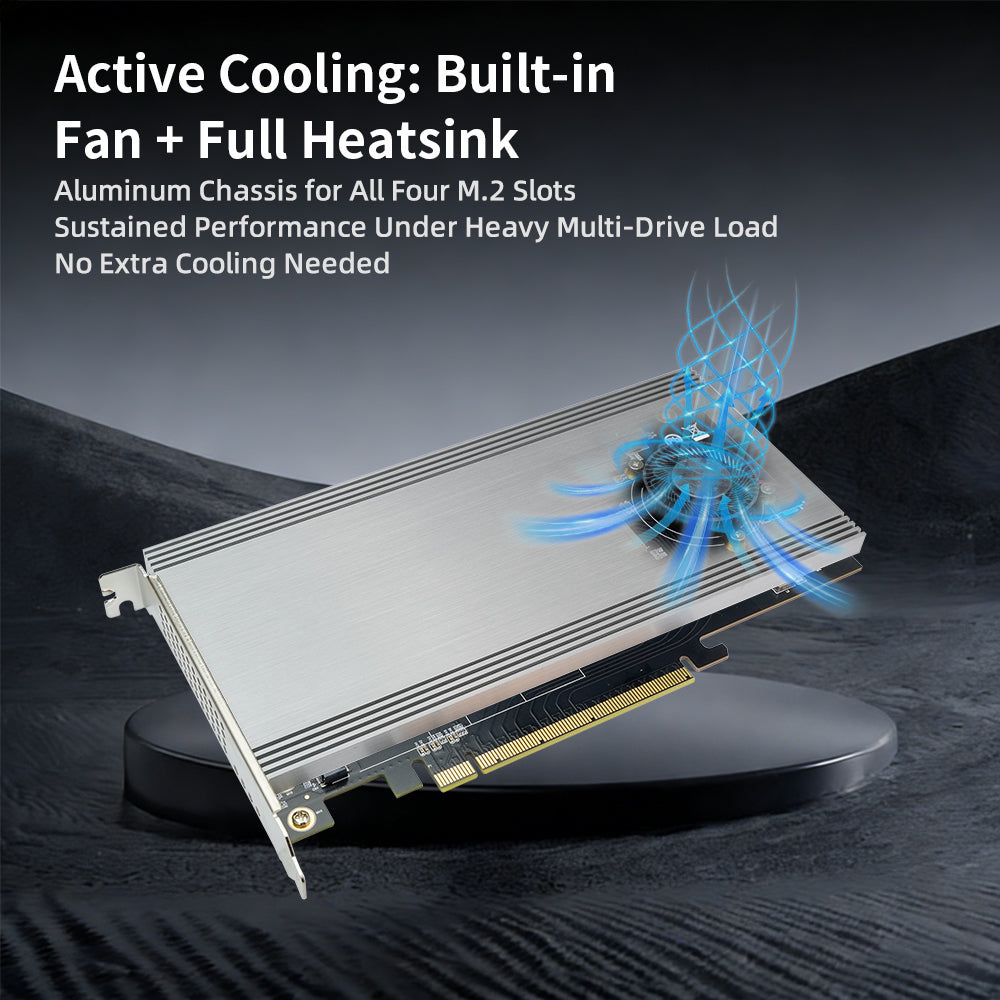
Q: What is the purpose of the large aluminium heatsink?
A: The heatsink is CNC-machined from a solid block of aluminium, covering both the IX8024 chip and the 4 SSD positions. High-conductivity thermal pads rapidly transfer heat from the chip and SSDs to the heatsink, significantly improving passive cooling efficiency - even with the fan stopped, safe temperatures can be maintained for short periods.
Q: How does the thermal design affect SSD lifespan?
A: The excellent cooling keeps SSD operating temperatures safely below the 70°C threshold, preventing accelerated NAND aging and controller throttling caused by high temperatures. It also reduces thermal expansion/contraction stress, lowering the risk of solder joint fatigue.
Q: Why is this card only compatible with 4U full-height chassis and not 2U?
A: The card uses a standard full-height bracket (approx. 120mm), and the combined thickness of the heatsink and fan module exceeds the low-profile bracket limit, making it unsuitable for the tight space of 2U rackmount servers. 4U and larger chassis, tower workstations, and full-height desktops are all compatible. For 2U users, please consider our low-profile version or U.2 adapter solutions.
Q: What are the specific PCIe slot requirements for this card?
A: The motherboard must have at least one PCIe 4.0 x8 or x16 physical slot (electrical x8 is sufficient). No motherboard Bifurcation support is needed - the IX8024 handles lane allocation independently. PCIe 3.0 x8/x16 slots can also be used, but speeds will drop to PCIe 3.0 x8 (64Gbps), halving the aggregate 4-drive bandwidth.
Q: Does it require additional power input?
A: No external SATA/Molex power is needed. The PCIe x16 slot can deliver up to 75W - far more than the card's maximum power draw. However, we recommend using a power supply rated at 550W or above to avoid insufficient power when multiple cards and high-end GPUs are used simultaneously.
Q: Does it support RAID functionality?
A: Hardware RAID is not provided, but it is fully compatible with software RAID solutions including Windows Storage Spaces, Linux mdadm/ZFS, and macOS Disk Utility. We recommend ZFS RAIDZ1/RAIDZ2 or Windows mirrored volumes, leveraging the IX8024's low latency for high-performance software RAID with far greater flexibility than hardware RAID controllers.
Q: Can it be used with virtualization platforms like ESXi or PVE?
A: Fully supported. VMware ESXi 7.0+ and Proxmox VE can directly recognise the 4 independent NVMe SSDs, supporting passthrough to VMs or building vSAN/Ceph distributed storage. The IX8024 has excellent IOMMU compatibility, and latency after passthrough is virtually identical to bare-metal, making it ideal for All-in-One virtualised storage nodes.
Q: Who is this product best suited for?
A: 1. Legacy motherboard upgraders: No Bifurcation required - older Z370/X470 boards can add 4 PCIe 4.0 SSDs. 2. Video editing workstations: 4-drive concurrent 13GB/s for stutter-free 8K RAW playback. 3. NAS/storage servers: Dense NVMe cache pool in 4U chassis with quiet fans. 4. AI training/deep learning: Parallel model loading with PCIe 4.0 x8 bandwidth to feed GPU data demands. 5. IT operations/test platforms: Quickly build multi-drive test environments with Bifurcation-free compatibility across various spare motherboards.