1
/
of
7
Lekuo M.2 B+M Key 10GbE SFP+ Network Card – Realtek RTL8127ATF, PCIe 3.0 x2, 1.79W Low Power for NAS, Server & Desktop
Regular price
$79.99 USD
Regular price
$120.16 USD
Sale price
$79.99 USD
Unit price
/
per
Taxes included.
Shipping calculated at checkout.
SKU:MR27F12
Couldn't load pickup availability
Share

Product Description
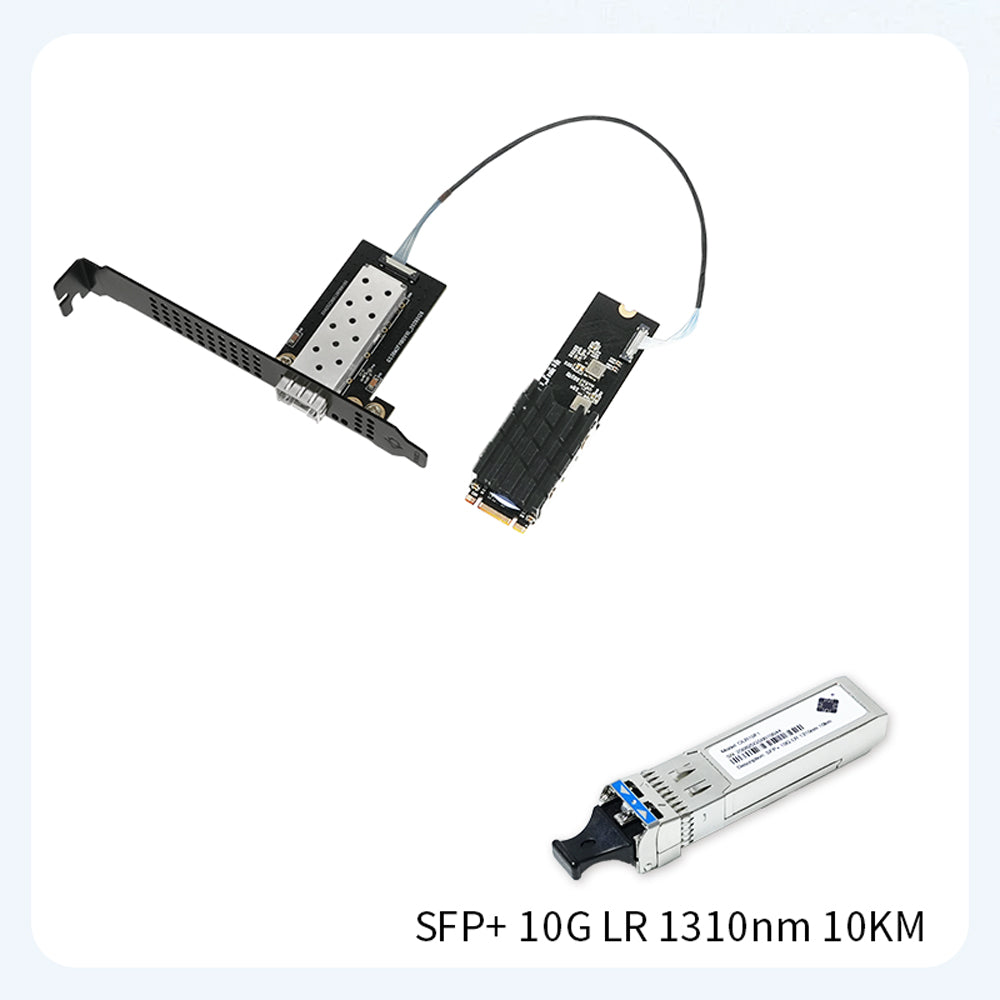
Lekuo M.2 B+M Key 10GbE SFP+ Network Card
Upgrade your NAS, server, or desktop to true 10 Gigabit Ethernet with the Lekuo M.2 SFP+ network card. Powered by the Realtek RTL8127ATF chipset and running on a PCIe 3.0 x2 interface, this card delivers blazing-fast 10GbE connectivity through a standard M.2 B+M Key slot — no full-size PCIe slot required.
Key Specifications
- Chipset: Realtek RTL8127ATF
- Interface: M.2 B+M Key (PCIe 3.0 x2)
- Port: 1× SFP+ (10GbE)
- Power Consumption: Only 1.79W — ultra-low power
- OS Support: Windows, Linux, major NAS platforms (Synology, QNAP, TrueNAS)


Why Choose Lekuo?
Lekuo specializes in high-performance networking hardware designed for reliability and compatibility. Our M.2 10GbE NIC is rigorously tested across major platforms to ensure plug-and-play performance right out of the box.
URL:https://lekuo.com/uploadfile/upload//data/upload/image/RTL8127.zip
Q: What is the core function of the MR27F12?
A: This product is an M.2 Key M to 10G SFP+ fibre optic network adapter. It utilizes a PCIe 3.0 x2 lane with a theoretical bandwidth of 16Gbps, sufficient to fully support 10Gbps optical module transmission. It features SFP+ hot-swap support and is compatible with both 10G and 1G SFP/SFP+ optical modules, with auto-negotiation down to Gigabit fibre.
Q: How do I interpret the LED indicator status?
A: The adapter board is equipped with an LED: Solid green = link established, Blinking green = data activity, Off = no link. This allows for quick physical-layer diagnostics without needing to log into the system.
Q: What are the advantages of the SFP+ fibre solution compared to 10G copper NICs?
A: ① Lower power consumption: SFP+ optical modules typically draw only 1–1.5W, far less than the 3–4W of 10GBASE-T copper ports, significantly reducing system heat; ② Lower latency: Optical transmission eliminates copper impedance losses, reducing end-to-end latency by 20–30%; ③ Superior interference immunity: Fibre is immune to electromagnetic interference, making it ideal for data centres, factories, and other harsh EMI environments; ④ Much longer reach: With single-mode optics, distances of 10km+ are achievable, whereas copper is limited to 100 metres.
Q: What types of SFP+ optical modules are supported?
A: It is compatible with mainstream 10G SFP+ modules, including: 850nm multi-mode SR (OM3/OM4 fibre, up to 300m), 1310nm single-mode LR (OS2 fibre, up to 10km), DAC high-speed cables (for short in-rack interconnects), and AOC active optical cables. 25G/40G modules are not supported – please do not mix them.
Q: Does it support 1G SFP optical modules?
A: Yes. When a 1G SFP module is inserted, it automatically negotiates down to 1Gbps, allowing it to be used as a Gigabit fibre uplink. This makes it easy to leverage existing Gigabit fibre assets while providing a seamless upgrade path to 10G in the future.
Q: What is the length of the included data cable? Can I replace it myself?
A: The standard cable length is 20cm. This cable uses a dedicated impedance-matched design. Do not substitute it with standard or non-spec cables, as this may cause PCIe signal degradation, packet loss, or even failure to be recognised.
Q: What are the specific M.2 slot requirements for this card?
A: It requires a M.2 Key M NVMe slot that is wired for PCIe (not SATA or USB). The slot must support at least PCIe 3.0 x2; PCIe 3.0 x4 or PCIe 4.0 x2 and above are recommended for optimal stability. PCIe 2.0 or lower slots are not recommended due to insufficient bandwidth leading to speed reduction.
Q: Is it compatible with both AMD and Intel platforms?
A: Yes, fully compatible across platforms. On the Intel side, it supports Z390/Z490/Z590/Z690/Z790 and B-series chipsets with native NVMe slots. On the AMD side, it supports X470/X570/B450/B550/X670/B650 and other chipsets with CPU or PCH-direct NVMe slots. M.2 slots provided by third-party RAID/HBA cards require validation of PCIe lane allocation.
Q: Which operating systems are supported?
A: Official drivers support Windows 10/11 (64-bit), Windows Server 2016/2019/2022, Linux (kernel 4.14+), VMware ESXi 6.7/7.0/8.0, and Proxmox VE.
Q: Does it require additional power input?
A: No external power is required. The SFP+ optical interface is very power-efficient, and the PCIe 3.0 x2 slot can supply up to 3.3V at 3A — far more than the combined power draw of the card and optical module. It runs stably purely from slot power, with no power cables to clutter your chassis.
Q: Does it support UEFI PXE network boot?
A: Yes. The card firmware includes a PXE ROM. You can enable Option ROM / PXE Boot in the BIOS to support diskless workstations, batch system deployment, or remote provisioning — ideal for enterprise IT operations and lab environments.
Q: Can it be used for Link Aggregation with the onboard NIC?
A: Yes. It supports IEEE 802.3ad LACP dynamic Link Aggregation. It can be teamed with onboard 1G/10G NICs or other MR27F12 cards to achieve bandwidth stacking and failover. LACP mode must also be configured on the switch side. This is ideal for high-availability scenarios such as NAS active-active setups or soft-router redundancy.
Q: Who is this product best suited for?
A: ① ITX/NUC mini-PC users: Add a 10G fibre port via the sole NVMe slot without occupying a full-size PCIe slot; ② NAS/All-in-One enthusiasts: Low-cost, low-power, silent 10G fibre LAN upgrades; ③ Industrial/edge computing: Shielded, interference-resistant design for harsh EMI environments; ④ Video editing workstations: Direct-attach 10G storage arrays for low-latency media playback; ⑤ Lab/test benches: Quickly deploy 10G fibre nodes with broad optical module compatibility.
A: This product is an M.2 Key M to 10G SFP+ fibre optic network adapter. It utilizes a PCIe 3.0 x2 lane with a theoretical bandwidth of 16Gbps, sufficient to fully support 10Gbps optical module transmission. It features SFP+ hot-swap support and is compatible with both 10G and 1G SFP/SFP+ optical modules, with auto-negotiation down to Gigabit fibre.
Q: How do I interpret the LED indicator status?
A: The adapter board is equipped with an LED: Solid green = link established, Blinking green = data activity, Off = no link. This allows for quick physical-layer diagnostics without needing to log into the system.
Q: What are the advantages of the SFP+ fibre solution compared to 10G copper NICs?
A: ① Lower power consumption: SFP+ optical modules typically draw only 1–1.5W, far less than the 3–4W of 10GBASE-T copper ports, significantly reducing system heat; ② Lower latency: Optical transmission eliminates copper impedance losses, reducing end-to-end latency by 20–30%; ③ Superior interference immunity: Fibre is immune to electromagnetic interference, making it ideal for data centres, factories, and other harsh EMI environments; ④ Much longer reach: With single-mode optics, distances of 10km+ are achievable, whereas copper is limited to 100 metres.
Q: What types of SFP+ optical modules are supported?
A: It is compatible with mainstream 10G SFP+ modules, including: 850nm multi-mode SR (OM3/OM4 fibre, up to 300m), 1310nm single-mode LR (OS2 fibre, up to 10km), DAC high-speed cables (for short in-rack interconnects), and AOC active optical cables. 25G/40G modules are not supported – please do not mix them.
Q: Does it support 1G SFP optical modules?
A: Yes. When a 1G SFP module is inserted, it automatically negotiates down to 1Gbps, allowing it to be used as a Gigabit fibre uplink. This makes it easy to leverage existing Gigabit fibre assets while providing a seamless upgrade path to 10G in the future.
Q: What is the length of the included data cable? Can I replace it myself?
A: The standard cable length is 20cm. This cable uses a dedicated impedance-matched design. Do not substitute it with standard or non-spec cables, as this may cause PCIe signal degradation, packet loss, or even failure to be recognised.
Q: What are the specific M.2 slot requirements for this card?
A: It requires a M.2 Key M NVMe slot that is wired for PCIe (not SATA or USB). The slot must support at least PCIe 3.0 x2; PCIe 3.0 x4 or PCIe 4.0 x2 and above are recommended for optimal stability. PCIe 2.0 or lower slots are not recommended due to insufficient bandwidth leading to speed reduction.
Q: Is it compatible with both AMD and Intel platforms?
A: Yes, fully compatible across platforms. On the Intel side, it supports Z390/Z490/Z590/Z690/Z790 and B-series chipsets with native NVMe slots. On the AMD side, it supports X470/X570/B450/B550/X670/B650 and other chipsets with CPU or PCH-direct NVMe slots. M.2 slots provided by third-party RAID/HBA cards require validation of PCIe lane allocation.
Q: Which operating systems are supported?
A: Official drivers support Windows 10/11 (64-bit), Windows Server 2016/2019/2022, Linux (kernel 4.14+), VMware ESXi 6.7/7.0/8.0, and Proxmox VE.
Q: Does it require additional power input?
A: No external power is required. The SFP+ optical interface is very power-efficient, and the PCIe 3.0 x2 slot can supply up to 3.3V at 3A — far more than the combined power draw of the card and optical module. It runs stably purely from slot power, with no power cables to clutter your chassis.
Q: Does it support UEFI PXE network boot?
A: Yes. The card firmware includes a PXE ROM. You can enable Option ROM / PXE Boot in the BIOS to support diskless workstations, batch system deployment, or remote provisioning — ideal for enterprise IT operations and lab environments.
Q: Can it be used for Link Aggregation with the onboard NIC?
A: Yes. It supports IEEE 802.3ad LACP dynamic Link Aggregation. It can be teamed with onboard 1G/10G NICs or other MR27F12 cards to achieve bandwidth stacking and failover. LACP mode must also be configured on the switch side. This is ideal for high-availability scenarios such as NAS active-active setups or soft-router redundancy.
Q: Who is this product best suited for?
A: ① ITX/NUC mini-PC users: Add a 10G fibre port via the sole NVMe slot without occupying a full-size PCIe slot; ② NAS/All-in-One enthusiasts: Low-cost, low-power, silent 10G fibre LAN upgrades; ③ Industrial/edge computing: Shielded, interference-resistant design for harsh EMI environments; ④ Video editing workstations: Direct-attach 10G storage arrays for low-latency media playback; ⑤ Lab/test benches: Quickly deploy 10G fibre nodes with broad optical module compatibility.