Lekuo USB-C 10GbE Ethernet Adapter (RTL8159)
A high-speed USB-C to 10Gb Ethernet adapter designed for laptops, NAS systems, and workstations that need reliable and flexible 10G networking without installing a PCIe card.

Fast 10G Networking via USB-C
Upgrade your system to 10Gb Ethernet using a simple USB-C connection. Ideal for users who need a portable 10G network solution without opening their device.
- Realtek RTL8159 chipset with multi-gig support
- Supports 10G / 5G / 2.5G / 1G / 100M speeds
- USB 3.2 Gen2x2 interface (up to 20Gbps bandwidth)
- Standard RJ45 port for easy deployment

Real-World Performance by Host Interface
Performance varies depending on your USB port type. Here are actual test results based on Lekuo DR59R11 (Realtek RTL8159) - results may vary by system.

| Host Interface |
Max USB Data Rate |
Actual Throughput |
| USB 3.0 (USB 3.2 Gen1) |
5 Gbps |
3.54 - 3.92 Gbps |
| USB 3.1 (USB 3.2 Gen2) |
10 Gbps |
7.21 - 7.44 Gbps |
| USB 3.2 Gen2x2 |
20 Gbps |
9.12 - 9.49 Gbps ✓ Full 10G |
| Thunderbolt 3 |
40 Gbps (USB 5/10 Gbps mode) |
3.54 - 6.01 Gbps* |
| Thunderbolt 4 |
40 Gbps (USB 10 Gbps mode) |
7.11 - 7.44 Gbps* |
| Thunderbolt 5 |
80 Gbps (USB 10 Gbps mode) |
5.92 - 6.25 Gbps* |
| USB4 |
40 Gbps (USB 10 Gbps mode) |
7.11 - 7.44 Gbps* |
*Note: Thunderbolt and USB4 ports often operate in "USB compatibility mode" when connected to non-Thunderbolt devices. Actual speed depends on host controller implementation.
Throughput measured with iperf3 over Cat6a cable, 10GbE NAS, and optimal network conditions.
Fanless Design - Silent and Efficient
Unlike many high-speed network adapters, this USB-C 10GbE adapter features a completely fanless design with excellent heat dissipation.

- 0dB noise - completely silent operation
- Aluminum heat sink for passive cooling
- No moving parts - higher reliability
- Perfect for quiet home office or studio environments
Wide System Compatibility
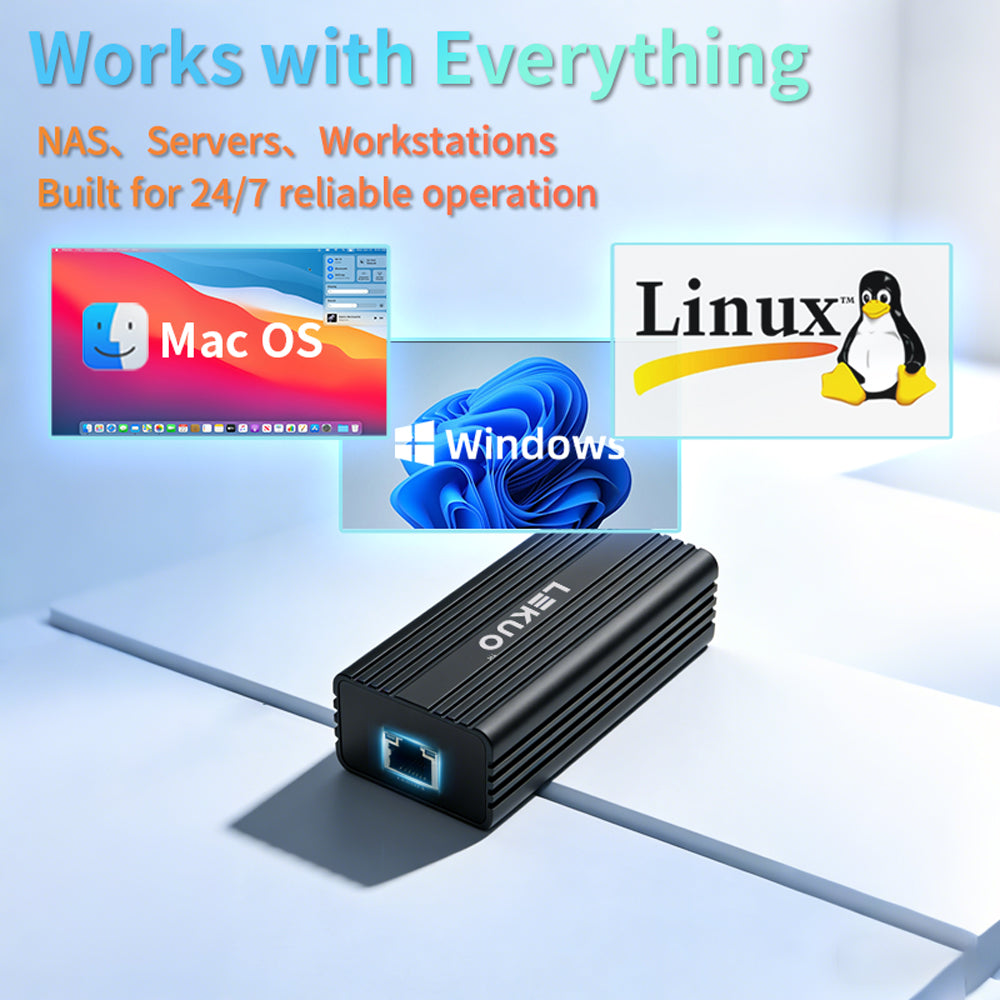
Compatible with multiple operating systems. macOS offers plug-and-play convenience, while Windows and Linux require driver installation for optimal performance.

-
Windows 10/11: Driver installation required
-
Linux: Driver installation required (kernel support available)
-
macOS: ✓ Plug & Play - No driver needed
-
iOS/iPhone: Limited use (compatibility varies)
Designed for Real-World Use Cases

- Perfect 10G Ethernet adapter for NAS and homelab setups
- Ideal for video editors working with large 4K/8K files
- Suitable for engineers transferring large datasets
- Best choice for laptops without built-in Ethernet ports

Why Choose USB 10G Instead of PCIe?
Compared to traditional PCIe network cards, this USB-C 10Gb Ethernet adapter offers a more flexible and accessible way to upgrade your network.
- No need to open your device or install hardware
- Works with standard RJ45 Ethernet infrastructure
- More portable than internal NIC solutions
- Lower barrier to entry for 10G networking
Complete Package & Specifications

Technical Specifications:
-
Interface: USB-C (USB 3.2 Gen2x2, backward compatible)
-
Chipset: Realtek RTL8159
-
Ports: 1 × RJ45 Ethernet
-
Speed: 10G / 5G / 2.5G / 1G / 100M / 10M auto-negotiation
-
Compatibility: Laptop, Desktop, Mini PC, NAS
-
Cable Requirement: Cat6a or above recommended for 10G
-
OS Support: Windows 10/11, Linux, macOS, iOS/iPhone
Package Contents:
- 1 × USB-C 10GbE Ethernet Adapter
- 1 × User Manual

URL:https://lekuo.com/uploadfile/upload//data/upload/image/RTL8159.zip
Q: Can I use this 10G adapter with Apple MacBook and iMac? Does it require a driver?
A: Fully supported, and it is plug-and-play with no driver required on macOS. However, please note that when a Mac's Thunderbolt (Thunderbolt 3/4) or USB4 port connects to a non-Thunderbolt USB 10G NIC, it typically runs in "USB compatibility mode" (10Gbps), so the actual throughput on Macs is capped at approximately 7.2 Gbps.
Q: Why does my Thunderbolt 4 / USB4 port only deliver around 7 Gbps in speed tests, far below the 9.4 Gbps 10G maximum?
A: This is determined by Intel's Thunderbolt controller and the underlying USB4 protocol allocation mechanism. When Thunderbolt 3/4 and USB4 ports are backward-compatible with non-Thunderbolt 10G devices, they typically allocate only 10 Gbps of USB data bandwidth and cannot activate 20 Gbps mode. To achieve the full 9.4 Gbps speed, we recommend using a PC with a USB 3.2 Gen2x2 (20Gbps) independent controller.
Q: Is this NIC compatible with Synology, QNAP, and other NAS devices?
A: Compatible, but some systems may require third-party drivers. On Linux-core NAS systems or self-built Xpenology, you can download and install the corresponding RTL8159 driver from open-source communities like GitHub. For slim NAS devices without PCIe expansion slots, this is an excellent low-power 10G upgrade solution.
Q: Does this 10G NIC generate a lot of heat? Will it overheat and disconnect during prolonged downloading?
A: Any 10GBASE-T NIC generates noticeable heat during operation. However, thanks to the RTL8159 chip's low-power design and the high-thermal-conductivity aluminum alloy housing with heat-dissipating fins, its thermal control is significantly better than older 10G NICs. The housing will feel warm under sustained full load, which is normal thermal exchange and will not cause throttling or disconnection.
Q: Does it support PVE (Proxmox VE), ESXi virtual machines, or OpenWrt soft router systems?
A: Yes. In PVE and mainstream Linux environments, RTL8159 has good system and community driver support. For OpenWrt soft routers, as long as your firmware includes the Realtek USB 10G NIC driver, you can use it as a 10G WAN/LAN port, making it ideal for building a compact 10G soft router.
Q: What are the cable requirements? Can I use standard Cat6 cables?
A: To ensure stable 10G speeds and signal integrity, we strongly recommend using Cat6a (Augmented Category 6) or Cat7/Cat8 cables. Over short distances (within 5 meters), high-quality genuine Cat6 cables might negotiate 10G, but over longer distances they are prone to dropping to 5G or 2.5G, or even experiencing frequent packet loss.
Q: Does this product support Jumbo Frames and Wake-on-LAN (WoL)?
A: Fully supported. The adapter supports Jumbo Frames up to 16KB, which significantly reduces CPU overhead when transferring large files between a NAS and a PC over the LAN. It also fully supports Wake-on-LAN functionality.
Q: Can this USB 10G NIC connect to standard 2.5G or 1G (Gigabit) switches?
A: Absolutely, it is fully downward-compatible. The adapter features advanced Auto-Negotiation technology, supporting not only 10G but also 5G, 2.5G, 1G (Gigabit), as well as 100M/10M speeds. It automatically negotiates with the maximum speed supported by your connected switch or router port, achieving seamless speed fallback.
Q: Can I use this NIC for link aggregation (Teaming/Bonding) to combine bandwidth on Windows 10/11?
A: It depends on the OS and controller. Windows 10/11 consumer editions have removed the standard NIC teaming feature. However, if you are using Linux, PVE, self-built NAS (e.g., Xpenology), or Windows Server, you can fully leverage built-in LACP or Bonding protocols to combine this NIC with others for link redundancy or bandwidth stacking.
Q: If my computer doesn't have a USB-C port, can I use a regular USB-A adapter?
A: It is usable, but strongly not recommended. Using a regular USB-A (USB 3.0) adapter limits the host port bandwidth to 5Gbps or even less, which drops the actual throughput of this 10G NIC to around 3.5 Gbps. Additionally, 10G NICs draw significant power, and many USB-A ports (especially front-panel ports) may not provide sufficient power, leading to disconnection issues.
Q: Does this adapter support Wake-on-LAN (WoL)? Do I need to adjust BIOS settings?
A: The hardware fully supports WoL. However, since it is powered via the USB bus, after your computer shuts down (S5 state), your motherboard BIOS must enable "Allow USB devices to wake the system" or disable "ErP support" to maintain standby power to the USB ports, enabling remote wake-on-LAN functionality.
Q: Why is my speed slower on Thunderbolt 3/4/5 than on USB 3.2 Gen2x2? Is the adapter defective?
A: No, this is completely normal behavior — not a defect. Thunderbolt ports use Intel's controller, which allocates USB bandwidth in compatibility mode (max 10 Gbps tunnel). This means the actual throughput is limited to ~7 Gbps on Thunderbolt 4/USB4, and ~3.5–6 Gbps on Thunderbolt 3. To unlock the full 9.4 Gbps 10G speed, connect to a native USB 3.2 Gen2x2 port (20 Gbps). Check your PC specs or motherboard manual to identify if you have a Gen2x2 port — it is often labeled "USB 3.2 Gen2x2" or "20G" on the port or in device manager.
Reliable 10G Networking Without Complexity
This USB-C 10Gb Ethernet adapter is designed for users who want high-speed networking without the complexity of PCIe installation or fiber-based SFP+ setups. It offers a balanced solution between performance, flexibility, and ease of use.